machine learning
This project investigates global hunger and food security trends, with focused analysis on the Philippines’ progress in combating malnutrition and food insecurity. Using data-driven forecasting, we identify key patterns in food security indicators and project future trajectories. Our analysis determines whether the Philippines is on pace to meet the UN’s Zero Hunger target by 2030 based on current trends. The findings provide a data-backed foundation for understanding gaps and opportunities in hunger alleviation efforts. By translating trends into clear visualizations, this project offers a measurable benchmark for tracking progress against global goals. It may also provide an opportunity for analysis on what possible solutions there may be to further aid in the reduction of hunger.
results
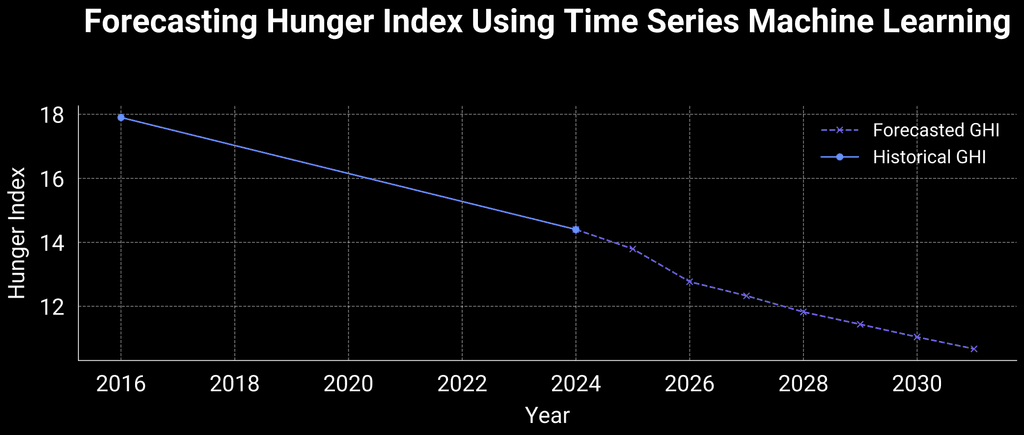
The graph illustrates the historical and projected trends of the Global Hunger Index (GHI) in the Philippines from 2016 to 2030, showing a consistent decline in hunger levels over time. Historical data from 2000 to 2024 reveals a steady reduction in GHI scores, highlighting the country's progress in improving food security, nutrition, and child health. The visualization clearly distinguishes between actual recorded values (represented by a solid line) and forecasted figures (shown with a dashed line), providing a visual reference for understanding future expectations based on past trends.
This projection is generated using a time series machine learning approach—specifically a linear regression model. The forecast anticipates a continued downward trajectory in the hunger index, projecting that the Philippines may reach even lower GHI levels by 2030 if present conditions and policy interventions persist. The results support optimism for continued improvement, though they also emphasize the importance of sustained efforts to maintain this momentum.
MEET THE TEAM
Coding a hunger-free Tomorrow




Exploratory Data Analysis (EDA)
Exploratory data analysis
The analysis will include a comprehensive summary of the data trends, visualizations, and a detailed exploration of the relationships between food security factors and hunger reduction.