Overview
In this analysis, we explore key trends and patterns in the Philippines' food security and hunger data to understand its progress toward the 2030 hunger reduction goals. By examining various factors, such as dietary energy supply adequacy, and global hunger trends, we aim to answer key questions about the country’s progress relative to global standards and identify which food security factors are most influential. Through the EDA process, we also highlight insights that could help us predict future hunger levels and determine whether the country is on track to achieve hunger reduction by 2030.
The dataset was standardized by assigning entries to four time ranges (1998–2004, 2005–2012, 2013–2020, 2021–2024) based on their start year to ensure continuity and eliminate overlaps. Multi-year entries were grouped by their starting date, even if they spanned into subsequent ranges. Inconsistent year formats were cleaned, and edge cases were resolved by prioritizing the initial year. This method guarantees full coverage from 1998 to 2024 with no gaps or redundancies.
In addition to standardizing the time ranges, we also did the following in cleaning the data.
Handling missing values: For both GHI scores and food security indicators, we decided to drop rows that had key columns missing. For GHI scores, we dropped rows whose hunger index data was not present in the reshaped training data. For food security indicators, we first dropped rows whose reference years were not within the years we counted for training data.
Conversion to numeric data: Using pandas, we converted data within certain columns such as the year for both datasets, hunger index for GHI scores, or indicator value for the food insecurity data set into numeric data.
The team plans to use time series forecasting models to predict future hunger trends in the Philippines. These models will leverage historical data to identify patterns and project future outcomes. Visualization tools will support the interpretation of these predictions.
The team utilizes data visualization tools like Matplotlib, Seaborn, and Plotly in Python to create charts and graphs that analyze trends and patterns in hunger and food security data. The resulting visuals will be tailored to highlight comparisons between the Philippines and global trends.
The team validates and tests the data using statistical analysis techniques to ensure accuracy and reliability in predictions. This involves assessing model performance with metrics like mean squared error. The process also includes cross-validation to confirm the robustness of the findings.
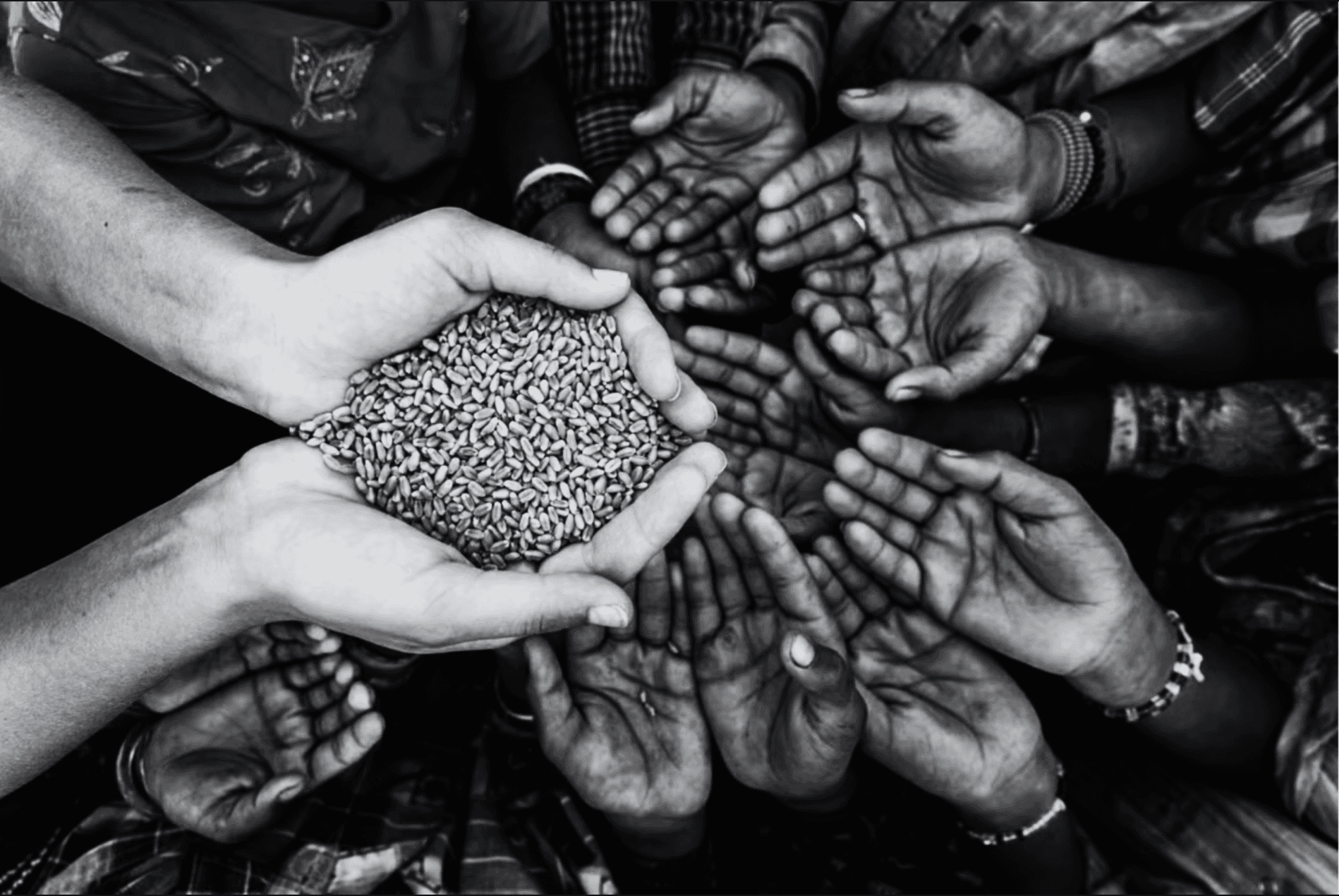
Image Illustration: iStockphoto.com
Key Questions & Hypothesis
Our project, "Predicting Hunger Reduction in the Philippines: Analyzing Food Security Factors and Progress Toward 2030," aims to explore the current state of hunger reduction in the Philippines and how it aligns with global trends. As we look toward 2030, we are investigating the key factors influencing food security and hunger levels in the country, with a focus on whether the Philippines is on track to meet the global hunger reduction target.
Key Research Questions:
Through this analysis, we seek to answer several critical questions:
How does the Philippines’ progress in reducing hunger compare to global trends?
What are the key food security factors influencing hunger reduction in the Philippines?
What are the projected hunger levels in the Philippines by 2030?
Our Hypothesis:
The Philippines' hunger reduction progresses more slowly than the global average.
Key food security factors such as GDP per capita, dietary energy supply, and protein supply influence hunger reduction in the Philippines; and Hunger reduction in the Phlippines has decreased due to increased GDP per capita, increased dietary energy supply, and higher protein supply.
Hunger in the Philippines will continue to decrease by 2030, should current trends continue.
01. How does the Philippines’ progress in reducing hunger compare to global trends?
The figure titled "Hunger Index Trends: Philippines vs Global (Training Data)" was created to visually compare the Philippines' progress in reducing hunger against global trends over the period from 1998 to 2024. The process began with the df_ghi_train dataset, which contains Global Hunger Index (GHI) scores for various countries, including the Philippines. The data was first cleaned by renaming columns to represent key time periods (e.g., "GHI Index Score by 2000 range (1998–2004)" to "2000") and then reshaped to transform it into a long format suitable for plotting. This format organized the data by country, year, and hunger index score. The dataset was filtered to create two subsets: one for the global average and another specifically for the Philippines. Using Seaborn’s lineplot function, two lines were plotted on a single graph—one representing the global average (in blue) and the other showing the Philippines' trend (in purple). Vertical dashed lines were added at key years (2000, 2008, 2016, 2024) with corresponding labels (e.g., "1998–2004") to mark the time ranges, ensuring clarity.
The df_ghi_train dataset was chosen for this analysis because it directly aligns with the first research question: understanding how the Philippines’ progress in reducing hunger compares to global trends. The dataset includes GHI scores across multiple countries and years (1998–2024), providing a standardized metric to measure hunger severity over time. Key columns used include 'Country' to isolate the Philippines, 'GHI Index Score by [year] range' (renamed to years like 2000, 2008, etc.), and the resulting 'hunger_index' values after reshaping. This dataset is ideal because the GHI is a comprehensive index that combines undernourishment, child wasting, child stunting, and child mortality, offering a holistic view of hunger. Using the training portion (df_ghi_train) ensures consistency with the project’s methodology, as it prepares the data for future predictive modeling while avoiding data leakage.
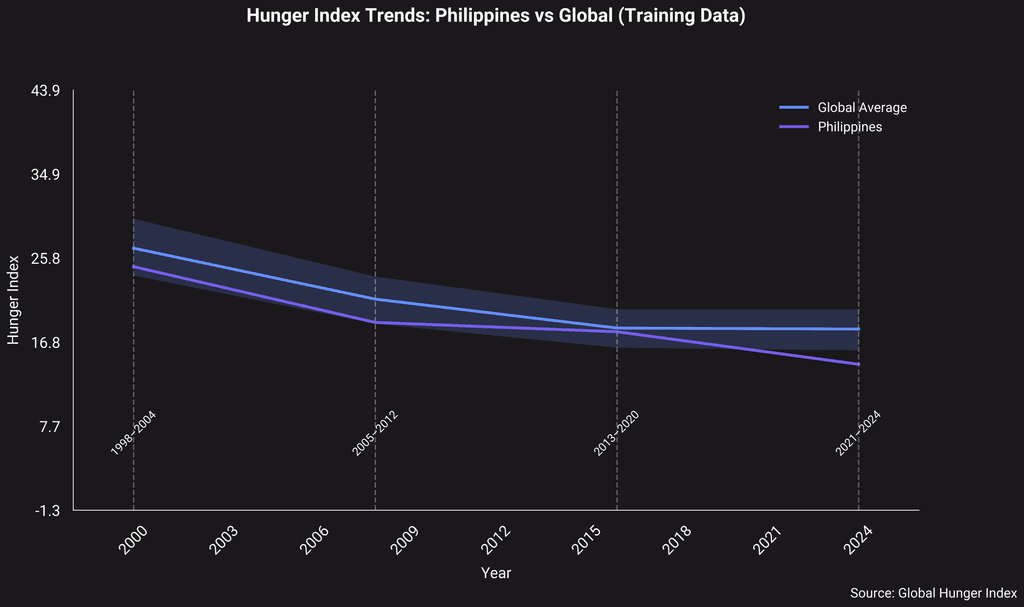
Interpreting the figure provides valuable insights into the Philippines’ hunger reduction efforts compared to the global average. The graph shows a clear downward trend in the GHI scores for both the global average and the Philippines, indicating progress in reducing hunger over the 26-year span. The global average starts at approximately 26 in 2000 and declines steadily to around 22 by 2024, reflecting a broad global improvement. The Philippines follows a similar trajectory, beginning at around 25.8 in 2000 and dropping to 16.8 by 2024. This suggests that while the Philippines has made efforts in reducing hunger, its progress has been slower than the global pace. This gap highlights challenges specific to the Philippines, such as economic disparities or food access issues, despite improvements over time. The steady decline in both lines supports the hypothesis that hunger is decreasing, but the slower rate in the Philippines shows the need for efforts to close the gap with global trends.
02. What are the key food security factors influencing hunger reduction in the Philippines?
The figure titled “Food Security Indicators in the Philippines (Training Data)” presents a 3x3 grid of line charts that track the evolution of nine key food security metrics from 1998 to 2024. These indicators include Dietary Energy Adequacy (%), Dietary Energy Supply (kcal/cap/day), Protein Supply (g/cap/day), Animal Protein Supply (g/cap/day), GDP per Capita ($), Undernourishment (%), Undernourished Population (in millions), Food Insecurity (%), and the Food Insecure Population (in millions). Built using the df_ph_train dataset, the visualization aims to provide a comprehensive view of the country's nutritional, economic, and food access trends over time.
To prepare the data, we first pivoted the dataset to organize values by year and indicator. This structure allowed us to generate clear and consistent line plots using Matplotlib subplots. In instances where an indicator showed a strong correlation with undernourishment (greater than 0.5), we incorporated a secondary axis to better illustrate these relationships. This technique was particularly valuable for addressing our second research question: identifying which trends and interactions help explain the reduction of hunger in the Philippines. In doing so, we focused on economic growth, improvements in nutrition, and persistent food insecurity as key themes that align with our project’s hypothesis.
The selection of the df_ph_train dataset was intentional. Its detailed structure—featuring columns like 'GHI Reference Year', 'Item', and 'Value'—makes it well-suited for longitudinal analysis. Importantly, undernourishment was used as a focal point due to its inclusion in the Global Hunger Index (GHI), allowing us to quantitatively assess progress on hunger reduction. The training data spans more than two decades, enabling us to observe long-term patterns while ensuring consistency for future predictive modeling efforts. By combining this dataset with correlation analysis, we could test our hypothesis that metrics such as GDP per capita, energy supply, and protein availability play vital roles in addressing hunger.
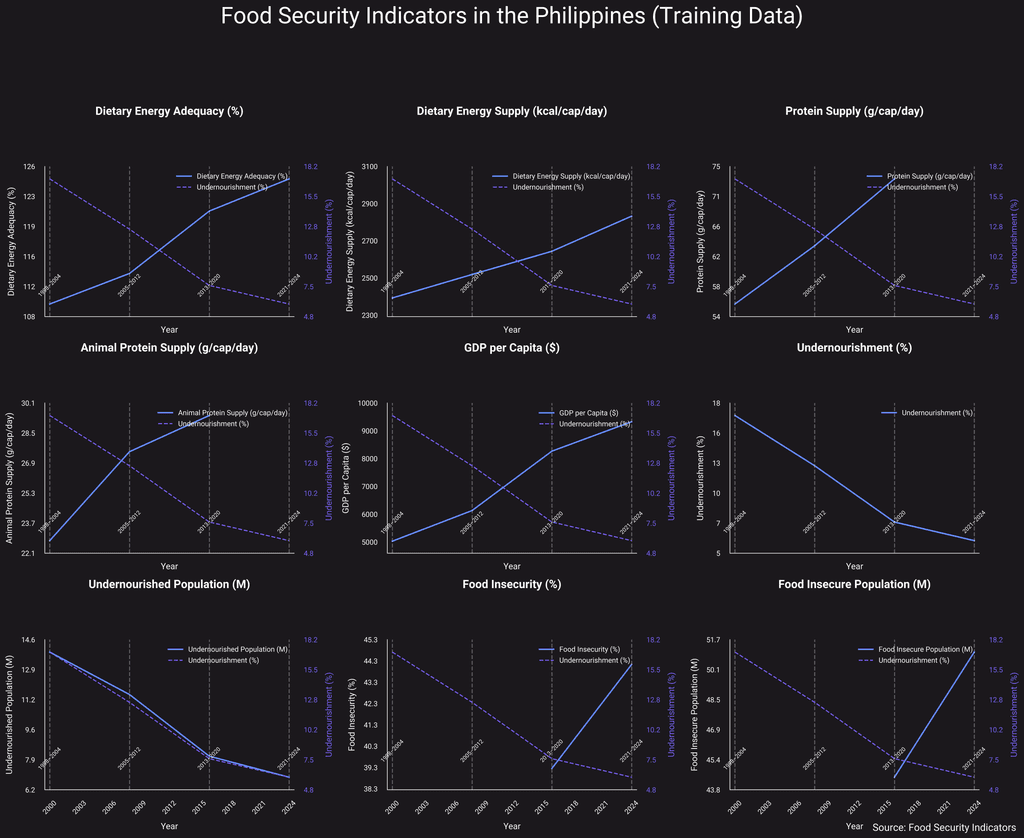
The resulting plots yield meaningful insights. Dietary Energy Adequacy rose from 110% to around 125%, while Dietary Energy Supply increased from 2392.2 to 2832.5 kcal per capita—both showing a clear inverse relationship with undernourishment, which fell from 17.1% to 5.9% over the same period. This underscores the impact of better energy access on reducing hunger. GDP per Capita nearly doubled—from about $5,028.2 to $9,325.7—mirroring a similar downward trend in undernourishment, and suggesting that economic development improves food access. Protein Supply also climbed, from around 55.6g to 73.0g per capita, showing a moderate correlation with hunger reduction. While these gains are encouraging, the continued presence of food insecurity especially in a country with strong agricultural potential. These data show that, while meaningful progress has been made, issues remain that needs attention.
03. What are the projected hunger levels in the Philippines by 2030?
The figure titled "Projected Hunger Index in the Philippines by 2030" was created to visualize the historical and forecasted hunger trends for the Philippines, addressing Question 3 of the research project. The process began with the df_ghi_train dataset, which contains Global Hunger Index (GHI) scores for various countries, including the Philippines, across key time periods (2000, 2008, 2016, 2024). The dataset was first cleaned by renaming columns to reflect specific years and reshaped into a long format with columns for country, year, and hunger index score. The data was filtered to isolate the Philippines’ records (df_ph_ghi_train). A linear regression model from sklearn.linear_model was then applied, using the years (2000, 2008, 2016, 2024) as the feature and GHI scores as the target, to predict future values up to 2030. The historical (2000–2024) and predicted (2024–2030) data were combined into a single DataFrame, with a "Type" column distinguishing between "Historical" (solid blue line) and "Predicted" (dashed purple line). Seaborn’s lineplot function was used to plot both segments on a single graph, with a vertical dashed line at 2024 marking the transition to predictions.
The df_ghi_train dataset was chosen for this analysis because it directly supports the objective of Question 3: predicting hunger levels in the Philippines by 2030. The dataset contains GHI scores for the Philippines across multiple years, providing a standardized and comprehensive metric to track hunger severity over time. Key columns used include 'Country' to filter for the Philippines, and the renamed year columns with corresponding GHI scores. The GHI is an ideal metric because it integrates four indicators—undernourishment, child wasting, child stunting, and child mortality—offering a holistic view of hunger that aligns with the research focus on food security.
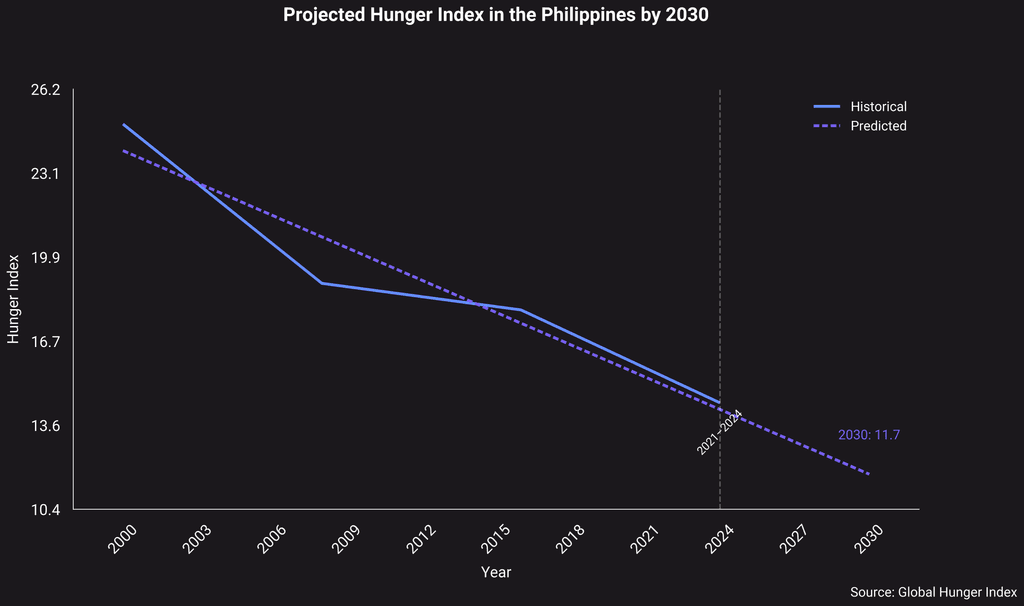
The historical data (2000–2024) shows a consistent decline in the GHI score, starting at around 25 in 2000 and dropping to less than 16.7 by 2024. This downward trend aligns with global efforts to combat hunger and suggests that interventions in the Philippines, such as improved food security policies, may have contributed to this progress. The predicted segment (2024–2030) continues this trend, projecting a further decrease to a GHI score of 11.7 by 2030. This value indicates that, if current trends persist, the Philippines is on track to achieve almost a "low" hunger level where GHI < 20 is typically classified as moderate, and <10 as low, by 2030. However, we can see that the linear model assumes a steady rate of decline, which does not account for other potential unexpected factors like economic crises and climate impacts.
Hypothesis testing
To deepen our understanding of the factors driving hunger reduction in the Philippines, we will perform hypothesis testing focused on identifying the most significant food security factors. This statistical approach will allow us to evaluate the relationship between various indicators and their influence on hunger levels. By testing this hypothesis, we aim to draw evidence-based conclusions about which factors play the most critical roles in shaping the country’s progress toward reducing hunger by 2030.
Hypothesis testing results
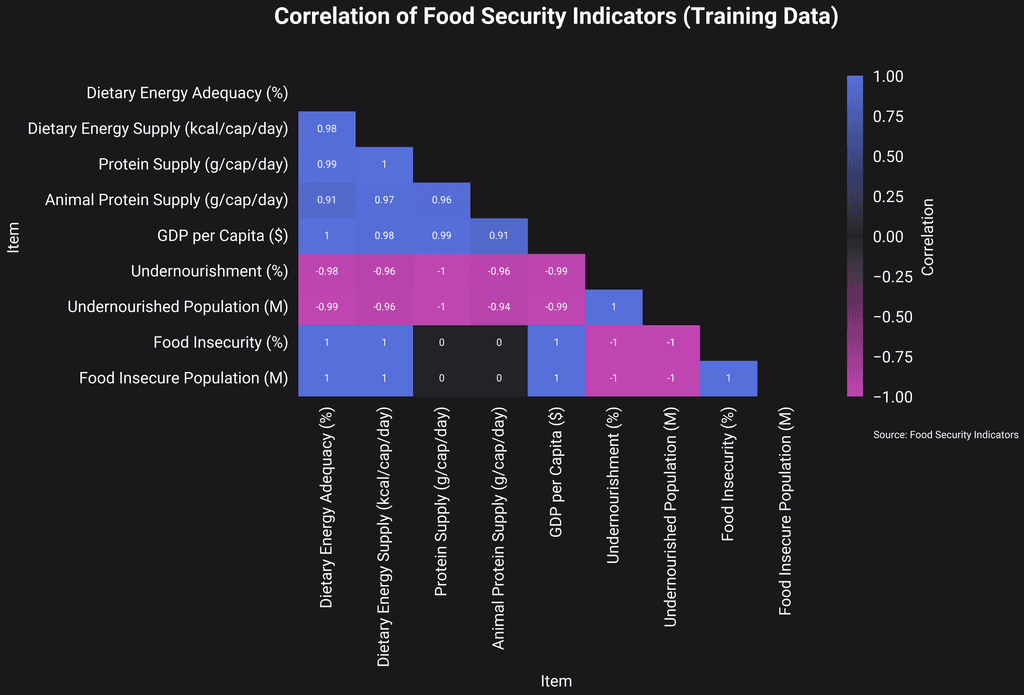
The correlation matrix reveals strong linear relationships among food security indicators, with several key findings. Most notably, undernourishment and undernourished population are strongly negatively correlated with indicators like protein supply, dietary energy adequacy, and GDP per capita (r ≈ -0.96 to -1.00), indicating that as these positive indicators increase, hunger levels tend to decrease significantly. Similarly, food insecurity and food insecure population are perfectly negatively correlated with these same positive indicators (r = -1), reinforcing their inverse relationship. Additionally, energy and protein supply indicators are almost perfectly positively correlated with one another and with GDP, suggesting interconnected improvements in nutrition and economic growth. Overall, the matrix provides clear evidence that improving dietary energy, protein access, and economic conditions strongly correlates with reducing hunger and food insecurity in the population.
rECOMMENDATIONS
We have the following recommendations for future improvements:
We recommend the use of data science in future studies that aim to identify the most significant factors in hunger and food insecurity.
Future studies should continue with projections for hunger levels in the Philippines and worldwide to help give awareness to the current and possible future situation of food insecurity.
MEET THE TEAM
Coding a hunger-free Tomorrow




Exploratory Data Analysis (EDA)
Exploratory data analysis
The analysis will include a comprehensive summary of the data trends, visualizations, and a detailed exploration of the relationships between food security factors and hunger reduction.